By Tenisha Taylor
The Woordfees and Aardklop’s 2025 staging of Boesman en Lena proves that Athol Fugard’s 1969 masterpiece is far from history. Performed on 19 October at Idas Valley Primary School, the production confronts apartheid not as a distant past, but as a lived, visceral reality – one that dehumanises its victims while forcing them to internalise the hierarchies imposed upon them.
The play presents a Coloured couple, Boesman and Lena, who have been forcibly displaced from the white-owned farms where they worked. It follows their harrowing journey to find shelter while grappling with loss, poverty, and the lingering violence of a society structured by racial oppression.
From the first scene, the weight of displacement is immediate. Boesman, played with explosive intensity by Brendon Daniels, drags himself across a barren landscape, shown by a single heap of sand and some sparse weeds. There are also a few props – their worn tarp, a torn mattress, thin blankets “wat nie eens warm hou nie” (“that don’t even keep warm”), battered cups, and bottles of wine – telling a story of relentless poverty and exploitation. Daniels’ every movement is heavy, punctuated by sudden jerks of rage and exhaustion, conveying a scarred body and spirit. Lena, portrayed with resilience by Veronique Jephtas, counters with careful, deliberate steps, her gestures embodying hope and dignity amid devastation. Their journey from Redhouse to Veerplaas, Swartkops, and Courthouse becomes a testament to endurance under relentless oppression, underscored by Boesman’s bitter line, “’n Mens kan nie nugter deur die lewe gaan nie” (“One cannot go through life sober”).
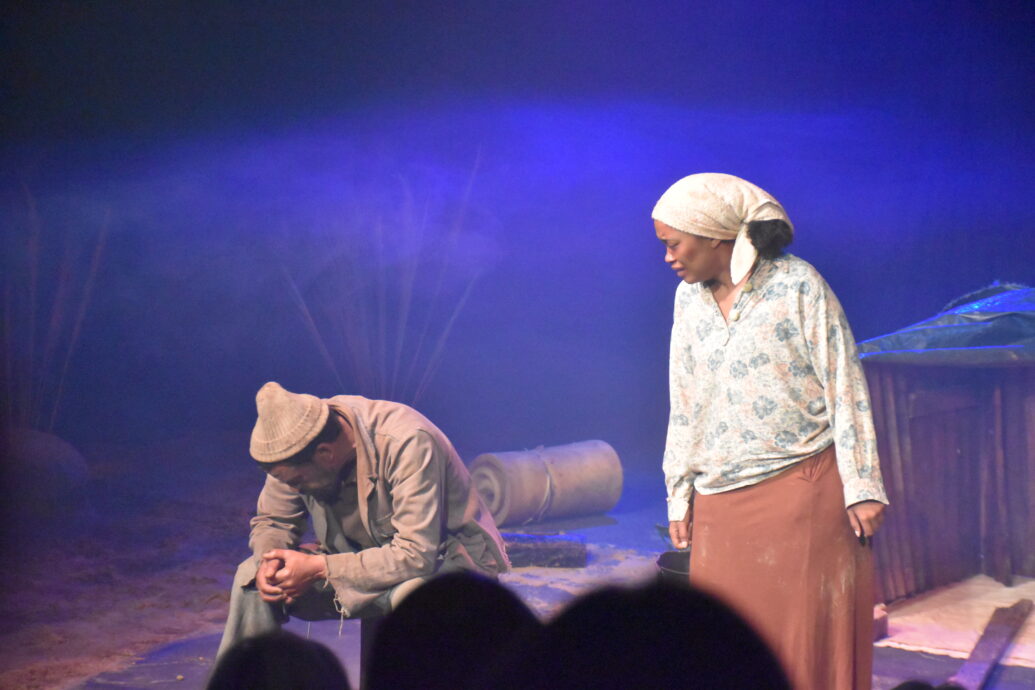
As they struggle to erect their makeshift shelter, tension simmers between them. Boesman lashes out violently, while Lena resists erasure, asserting her memory, perspective, and humanity. Her anguished question, “Hoekom het jy vir my geslaan en nie die baas wat ons weggejaag het nie?” (“Why did you hit me and not the boss who chased us away?”), captures how shared suffering and systemic injustice strain even the closest bonds. Every glance, every step, every gesture communicates the physical and psychological toll of displacement.
The arrival of Outa, a sick Black man played by Tshamano Sebe, intensifies the play’s exploration of apartheid-era hierarchies. Boesman refuses him shelter and strikes him, while repeatedly using a racial slur that visibly unsettled the audience. Their discomfort underscores the play’s unflinching depiction of oppression and the enduring power of language as a weapon. At the same time, Boesman acknowledges the oppression that has shaped his own life as “ons is die witman se vullis en hy raak befok omdat hy nie ontslae kan raak van die vullis nie” (“we are the white man’s trash, and he gets angry because he cannot get rid of the trash”).
Lena further underscores their dehumanisation when she says, “Boesman sê daar is nie ’n God vir onse mense nie” (“Boesman says there is no God for our people”). The play depicts a clear apartheid-enforced hierarchy: Black people occupy the lowest rung, while Coloured people, though oppressed, exert relative power, embodied in Boesman’s aggression toward Outa.
Lighting heightens the emotional tension, with cool blue hues marking Lena’s fleeting hope and a stark spotlight on Outa’s lifeless body confronting the audience with brutal consequences of systemic violence. In the final scenes, Boesman’s brief softening is mirrored in the yellow light as he listens to Lena and explains the route ahead, yet the unresolved ending reminds viewers that trauma and oppression endure beyond the stage.
Boesman en Lena is a raw, unflinching pursuit of freedom and truth. Through displacement, brutality and small acts of humanity, it leaves audiences haunted and reminded that the fight for justice and dignity is far from over.