Nationally, students are experiencing problems with student debt. SU students also face uncertainty regarding registration blocks and allowance disbursements. Die Matie reports that many of these problems seem to be a result of inconsistent NSFAS payments.
By Tenisha Taylor, Zandri van Greunen & Leah Falcon
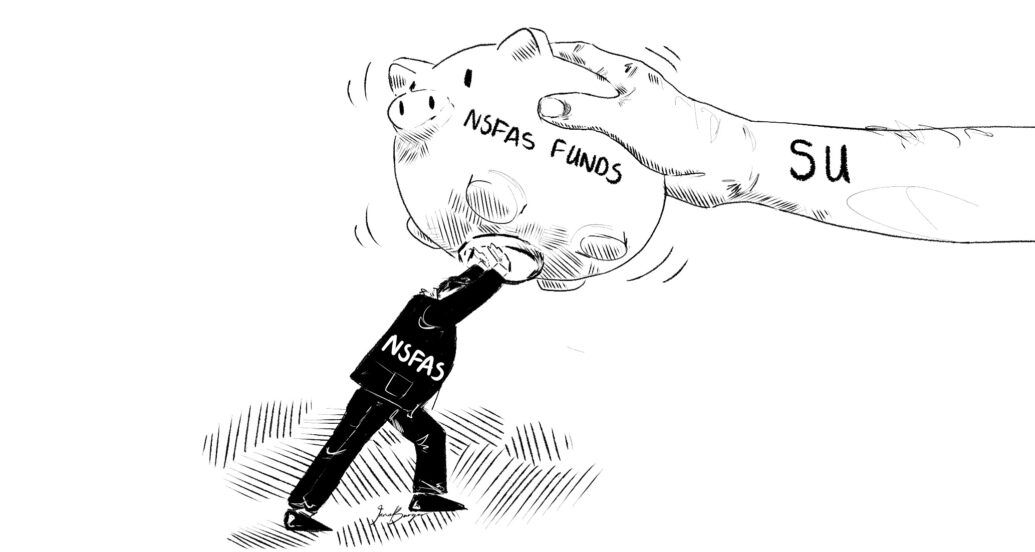
R286,2 million – this is how much the National Student Financial Aid Scheme (NSFAS) still owes Stellenbosch University (SU) for 2025 student fees.
Prof Nicola Smit, SU’s acting Chief Operating Officer (COO), said to Die Matie on Saturday, 7 February, that “SU has received two payments from NSFAS related to the outstanding 2025 balance. Unfortunately, the outstanding balance remains significant.” Although SU received R75,5 million from NSFAS during December 2025, NSFAS still owes SU over R286 million for 2025, Smit said.
By the time of print, SU has also not yet received a response from NSFAS regarding the university’s application to reclassify Stellenbosch as a metro area.
“Accommodation allowances are disbursed in line with NSFAS location classifications, with Tygerberg and Bellville classified metro, while the Stellenbosch campus classification remains non-metro, pending NSFAS confirmation.”
Smit also confirmed that, by the time of print, SU still awaits official correspondence from NSFAS confirming the 2026 allowances.
In response to Die Matie’s question whether the university has contacted NSFAS regarding outstanding payments and 2026 allowance caps, Smit said, “The SU’s COO and the Chief Director Finance have contacted NSFAS on various occasions.” However, no answers were received as of yet.
First payments for 2026
Smit confirmed to Die Matie that the university has “received the first payment from NSFAS for the 2026 academic year on 3 February”.
SU’s Centre for Undergraduate Bursaries and Loans (CUBL) is currently processing upfront
NSFAS allowance payments for February for students who appear on the official NSFAS funded list, have a funding status of “Funded” or “Provisionally Funded”, and completed required NSFAS compliance actions.
Smit said, “As the final 2026 NSFAS guidelines are still pending, these upfront payments will be based on the 2025 NSFAS capped amounts and cover one month’s
allowance for applicable categories.
“These upfront allowances form part of the annual NSFAS allowance package and are not additional funds. Changes to a student’s NSFAS funding status may [possibly] affect eligibility.”
Financial blocks and registration
As stipulated in Part 3 of the 2026 SU Yearbook (Student Fees), all amounts that are in arrears on the student fees account for a specific year have to be paid before the student will be allowed to register for a subsequent year of study.
However, by the time of print “a total of 6 158 financial blocks has been lifted to enable SU students to register. Of these 2 581 are NSFAS students,” Smit said to Die Matie.
Smit explained to Die Matie, “In addition to the case‑by‑case assessment and risk categorisation (low, medium, or high risk), we have applied an additional criterion, namely whether a student is funded by NSFAS or not. Students were checked against the current 2026 NSFAS provisionally funded list. Where a student did not appear on the list, an internal assessment was conducted to determine their potential eligibility for NSFAS funding for the 2026 academic year. This assessment is based on a criterion aligned with NSFAS requirements and was applied as an interim measure while awaiting final NSFAS funding outcomes for these students for 2026.
“In parallel, consideration was given to the availability of other confirmed funding sources, including external funding and/or sponsorships, with confirmation that the outstanding balance on the student account would be covered in full, in determining whether a financial block could be lifted.
“SU also lifted financial blocks for students who made a payment towards their outstanding balance and provided proof of payment, as well as for students affected by
NSFAS course or qualification code discrepancies,” Smit said.
Registration data for NSFAS
Smit explained to Die Matie that data provided to NSFAS is not limited to student registration information alone. SU provides a comprehensive dataset, which includes a student’s registration status, academic results, tuition fee information, accommodation details, and other approved financial arrangements relevant to the student’s funding.
“NSFAS sets formal window periods for institutions to upload registered student data. For the 2026 academic year, this period runs from 3 January to 31 March. During this time, the university uploads the information of registered students in line with NSFAS requirements to ensure that eligible students’ funding can be secured and released.
“Where adjustments are required after the formal deadline (due to late registrations or changes in students’ circumstances), the university engages directly with NSFAS to request extensions to manage these updates. These engagements continue throughout the academic year, in line with NSFAS processes,” Smit said.
Processes and systems
NSFAS funding is not paid to the university as a once-off amount. Instead, NSFAS releases funding to institutions in tranches, based on the official NSFAS funded list and the approved payment amounts for the relevant academic year.
According to Smit, NSFAS is responsible for confirming student funding on the NSFAS system, providing the university with the official NSFAS funded list for each academic year, and setting allowance categories and capped amounts for each academic year.
On the other hand, CUBL is responsible for processing and disbursing student allowances once funding is confirmed, calculating allowances based on students’ living arrangements recorded on SUNStudent.
Students must check that their personal details, banking details, and accommodation information on SUNStudent are accurate and remain unchanged throughout the year. Incorrect or incomplete information may result in delays in allowance payments.
Assistance from NSFAS
Smit said NSFAS has appointed Ms Michaela Brink from their head office to liaise with SU students on NSFAS‑related matters. “She is based at the Coetzenburg Centre and started on 5 February 2026.”
By the time of print, NSFAS had not yet responded to any queries from Die Matie.
‘WE ARE WORKING FOR STUDENTS’
Simiso Langa, the interim SRC Chair, said to Die Matie:
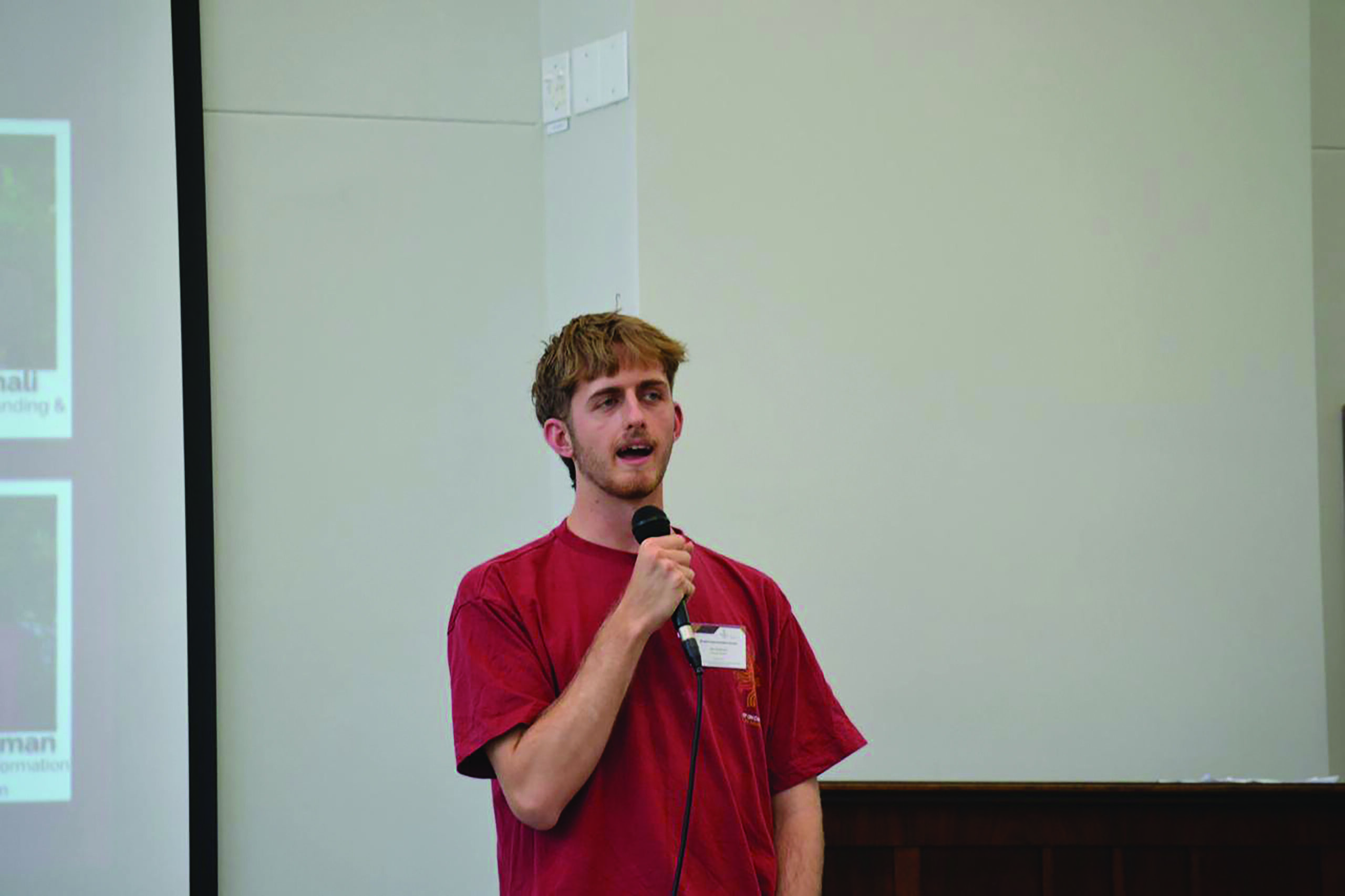
“The SRC can find out what is happening on the ground. The university has a matrix for the registration numbers, which is very helpful to contextualise what we are working with. But, regarding dignity for our students, we also try to make sure that management isn’t just looking at numbers, but [also] consider that they are working with students. Students are people and everyone deserves to have human dignity.
“Our primary role is to put pressure on upper management to consider those things and to constantly remind them that we are working for the students.
“I try to find solutions to help as many students as possible. We have been working behind the scenes for the past few weeks to help students. But we ask for some time. We are doing our best to reach as many students as possible.”
‘ENGAGE WITH US’
Natalie Nortje, Vice-Chair of the Prim Committee, said:
“The SRC is passionately committed to the welfare and service of students. Beyond our mandate, we lead with compassion, in an effort to understand the individual need of students and advocate for their needs. I would like to encourage students to engage with the SRC, and to be aware of the opportunities that are available to them.”