By Anica Hattingh
For eight years, the Stellenbosch University Facilities Management (SUFM) Green Living Awards have celebrated the environmental sustainability initiatives of students across the Stellenbosch University (SU) campus. The aim of the awards evening is to highlight the innovation and tenacity with which these students approach everyday tasks, inspiring positive change and a lasting impact on the campus community.
Even though the main focus of the evening was on the students, one award in particular stood out – the official Green Building Council of South Africa (GBCSA) Net Zero Carbon Certification of the Stellenbosch Institute for Advanced Study (STIAS) Extension. As the first net zero carbon building on the university campus – and the first at any South African university – it marked a significant milestone in SU’s ongoing commitment to sustainability and environmental innovation. The certification not only recognises the building’s energy efficiency and carbon-neutral design, but also sets a new benchmark for sustainable development in higher education.
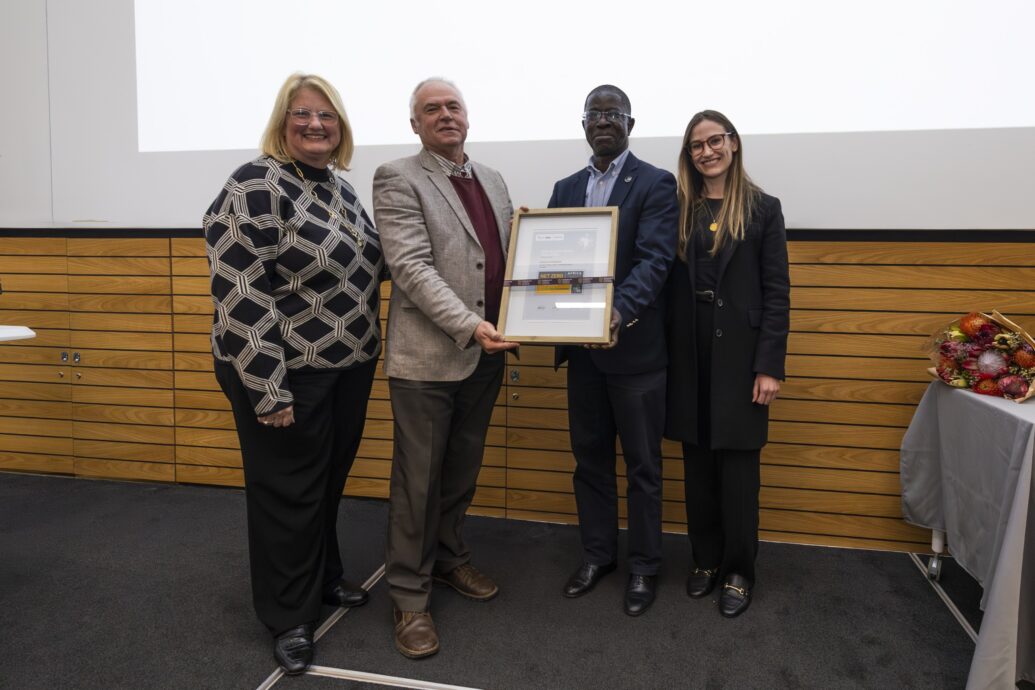
At this year’s SUFM Green Living Awards, hosted on Thursday, 2 October, STIAS Director Prof. Edward Kirumira and Japie Engelbrecht, SU’s Director of Planning and Development at Facilities Management, accepted the GBCSA Net Zero Carbon Certification award from Dannika Taylor, who represented the GBCSA and Imbue Sustainability. Imbue Sustainability assisted the project management team in ensuring that the building met the rigorous standards required for this certification.
Further demonstrating this commitment to a greener future, SU has adopted its first Environmental Sustainability Plan (ESP), which outlines the university’s ambitious journey to achieve net zero status by 2050. This plan underscores SU’s dedication to reducing its environmental footprint while fostering innovation and sustainability across all campus operations.
What is net carbon zero or net zero status?
Net carbon zero or net zero status refers to a state where the total amount of greenhouse gases emitted into the atmosphere is balanced by the amount removed or offset. This means that any carbon dioxide (CO₂) produced through activities such as energy use, transport or construction is counteracted by measures that absorb or eliminate an equivalent amount. These counteractive measures include renewable energy generation, energy efficiency improvements, or carbon offset projects. That being said, an organisation, institution or building – such as the STIAS Extension – obtains net carbon status once it operates without contributing to an overall increase in atmospheric carbon, helping to slow climate change and promote environmental sustainability.
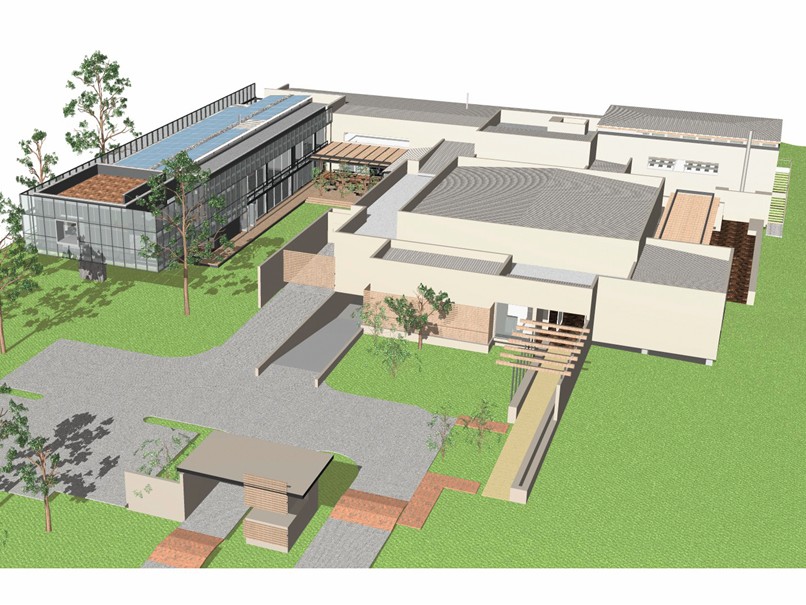
What makes the STIAS Extension net carbon zero?
The motivating factor behind the STIAS Extension is the commitment to contributing to a greener future and a healthier planet. With numerous energy-smart features – including efficient insulation, solar energy use, and water-saving systems – the building embodies sustainability in both design and function. Engelbrecht explains that a “46,8 kWp rooftop solar photovoltaic system generates clean, renewable energy that offsets the building’s operational consumption”. In addition, the building incorporates energy-efficient lighting, smart climate control, and materials selected for their low environmental impact. Together, these measures reduce carbon emissions from day-to-day operations, ensuring that the STIAS Extension achieves its net carbon zero status while setting a benchmark for sustainable development across South African university campuses.
The STIAS Extension is more than just a building; it is a symbol of SU’s vision for a sustainable future. By combining innovative design, renewable energy, and carbon-conscious practices, it demonstrates how higher-education institutions can lead the way in environmental stewardship. As students, staff and the broader community witness this milestone, it stands as a powerful example that a greener, carbon-neutral future is not only possible, but achievable.